
Evidence brief for clinic investors
Knee pain on stairs: what the research shows
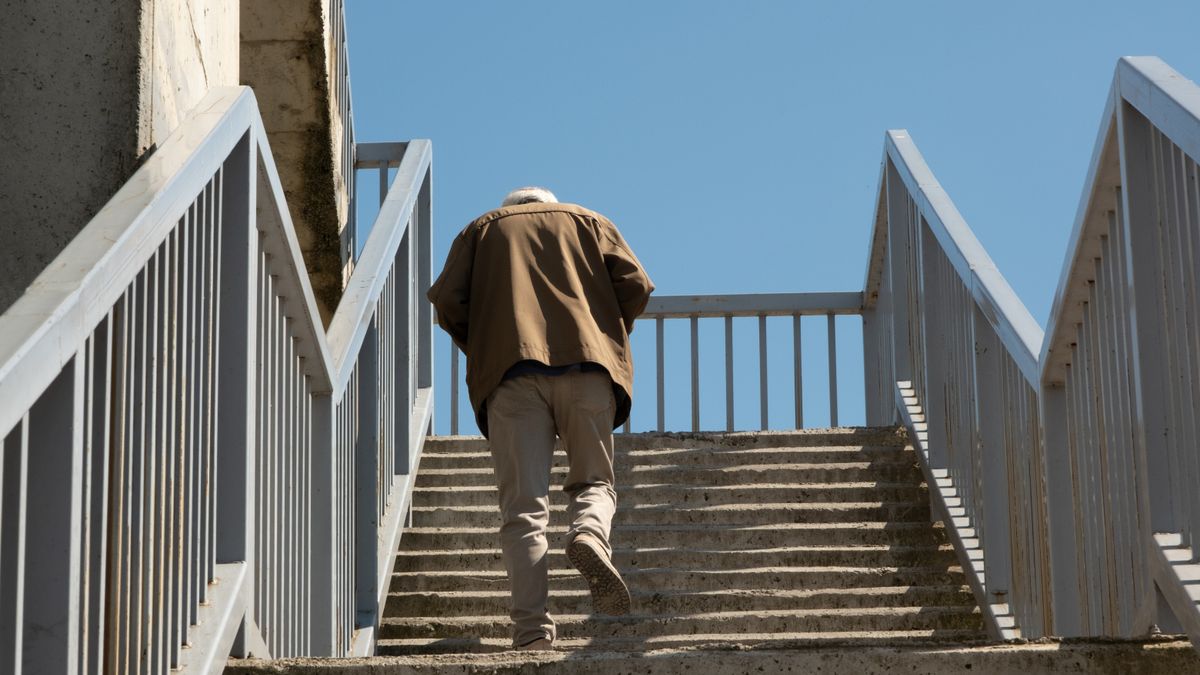
Pain that shows up on the stairs, and often more on the way down, is one of the most common ways people describe a knee problem. If you are evaluating a clinic business, this is a complaint your future clinicians will hear every week. Here is what the research says about which conditions sit behind it, what the guidelines list, and where the evidence on pulsed electromagnetic field (PEMF) technology stops.
Which knee conditions make stairs painful?
The two most studied are patellofemoral pain, felt around or behind the kneecap, and knee osteoarthritis. Stairs load the joint between the kneecap and the thigh bone with the knee bent under body weight, which is why both conditions tend to show up there.
Clinical practice guideline, patellofemoral pain (Willy et al., Journal of Orthopaedic & Sports Physical Therapy, 2019). Patellofemoral pain is described as pain of insidious onset localized to the front of the knee, around or behind the kneecap, that worsens with lower-limb loading activities such as squatting, prolonged sitting, ascending or descending stairs, jumping or running. Symptoms can restrict activity and work, and can recur and persist for years. (PubMed 31475628)
Repeated-measures gait study, 15 people with patellofemoral pain (Powers et al., Clinical Journal of Sport Medicine, 2004). The authors describe ascending and descending stairs as one of the most painful activities of daily living for this group. With a patellar brace, participants reported an average 56% decrease in pain, yet modeled peak patellofemoral joint stress on the stairs did not go down, because knee extensor moments and joint reaction forces rose. (PubMed 15273526)
The second study is a useful caution for any clinic model: reported pain and measured joint load do not always move together. Other causes of stair pain, such as meniscus problems or patellar tendon pain, and red flags like a hot, swollen knee, a knee that locks or gives way, or pain after a fall, need a physician's assessment rather than a general program.
What do guidelines recommend first for knee osteoarthritis?
Exercise and education come first in both major guidelines. Weight management, tai chi, a cane and bracing also appear. PEMF is not named in either guideline's summary.
OARSI guidelines for knee, hip and polyarticular osteoarthritis (Bannuru et al., Osteoarthritis and Cartilage, 2019). Evidence was sought for 60 interventions. Core treatments for knee osteoarthritis were arthritis education and structured land-based exercise programs, with or without dietary weight management. Topical NSAIDs were strongly recommended for knee osteoarthritis; acetaminophen was conditionally not recommended and opioids were strongly not recommended. The abstract does not name PEMF. (PubMed 31278997)
American College of Rheumatology / Arthritis Foundation guideline for osteoarthritis of the hand, hip and knee (Kolasinski et al., Arthritis Care & Research, 2020; the 2019 guideline). Strong recommendations included exercise, weight loss for people with knee or hip osteoarthritis who are overweight or obese, self-efficacy and self-management programs, tai chi, cane use, tibiofemoral bracing and topical NSAIDs for knee osteoarthritis. Patellofemoral bracing for patellofemoral knee osteoarthritis, balance exercises, yoga, acupuncture and thermal modalities received conditional recommendations. The abstract does not name PEMF. (PubMed 31908149)
How much does exercise help?
A modest, real amount. The 2024 Cochrane update on exercise for knee osteoarthritis found small-to-moderate improvements in pain and function, of uncertain clinical importance against its own thresholds. For patellofemoral pain, hip strengthening has the most consistent support.
Cochrane review, 139 randomized trials, 12,468 participants with knee osteoarthritis (Lawford et al., 2024). Against attention control or placebo, exercise improved pain by 8.70 points on a 0 to 100 scale (95% CI 5.70 to 11.70; low certainty) and physical function by 11.27 points (95% CI 7.64 to 15.09; moderate certainty). Against no treatment or usual care, pain improved by 13.14 points. No type of exercise did better than another. Confidence intervals either did not reach the minimal important differences used (12 points for pain, 13 for function) or included both important and unimportant effects, and most participants were not blinded. (PubMed 39625083)
Randomized trial, 82 women aged 50 to 70 with knee osteoarthritis (Wang et al., Clinical Rehabilitation, 2020). Six weeks of supervised hip abductor strengthening against quadriceps strengthening. The hip group reported fewer functional difficulties at weeks 6 and 12 (P < 0.001) and did better on the stair ascent and descent task and a figure-of-8 walk, but not on sit-to-stand. Pain was lower in the hip group at week 6 but not at week 12; 72 women completed the study. (PubMed 31505954)
Systematic review, 7 randomized trials of hip strengthening in patellofemoral pain (Santos et al., Brazilian Journal of Physical Therapy, 2015). The trials showed hip strengthening reduced pain, and five found better function. They disagreed on whether muscle strength itself increased. (PubMed 26039034)
Did any PEMF trial measure pain on stairs?
One trial measured it directly, against laser rather than sham. Most PEMF trials in the knee measured overall pain and function scores, not stairs specifically.
Randomized trial, 40 participants with early knee osteoarthritis (Kellgren-Lawrence grade 2 to 3) (Elboim-Gabyzon & Nahhas, University of Haifa, BMC Geriatrics, 2023). Six 15-minute sessions over 3 weeks of PEMF or low-level laser. Both groups improved (p < 0.0001). PEMF was more effective in reducing pain at rest, when standing from a sitting position and when climbing stairs, and in improving WOMAC scores and the timed up-and-go test (p ≤ 0.0003). Improvements in pain during activities and WOMAC reached the minimal clinically important difference. No adverse events occurred. There was no sham arm, and measurements were taken right after the last session with no follow-up. (PubMed 36922781)
What does PEMF research show for knee osteoarthritis overall?
A modest effect on pain in pooled analyses, with less on function and wide variation between trials. The Cochrane review (PubMed 24338431) found pain about 15 points lower than sham on a 0 to 100 scale and no significant difference in physical function. Full detail is in our knee osteoarthritis brief.
Cochrane review, 9 randomized trials against placebo or sham (Li et al., 2013). Pain improved by 15.10 points more than sham on a 0 to 100 scale (95% CI 9.08 to 21.13) after 4 to 26 weeks: 26 points with electromagnetic fields against 11 with sham. Physical function (mean difference 4.55; 95% CI −2.23 to 11.32) and quality of life did not differ significantly, adverse events did not differ from sham, and no serious adverse events were reported. (PubMed 24338431)
Meta-analysis, 12 sham-controlled trials, 10 of them in the knee (Wu et al., BMJ Open, 2018). Knee pain: standardized mean difference −0.54 (95% CI −1.04 to −0.04; p=0.03), with heterogeneity of I²=88%. Knee function: −0.34 (95% CI −0.53 to −0.14; p=0.0006). Adverse events did not differ from sham in the 3 trials that reported them. The pain estimate is small to moderate and its interval comes close to zero. (PubMed 30552258)
What about patellofemoral pain?
Thinner evidence. A 2018 meta-analysis of conservative options for patellofemoral pain (PubMed 29392329) included one PEMF-plus-exercise result alongside hip strengthening and bracing, and found that most trials in the field showed no clinically significant benefit. Our anterior knee pain brief covers the individual trials.
Systematic review and meta-analysis, 37 randomized trials of conservative approaches for patellofemoral pain (Saltychev et al., Journal of Rehabilitation Medicine, 2018). More than 80% of the 37 trials showed no clinically significant benefit. Among those that did, PEMF added to home exercise gave a pain difference of −33.0 (95% CI −45.2 to −20.8), hip strengthening −65.0 and −32.0, and patellar bracing −31.6. (PubMed 29392329)
Where does the PEMF evidence stop?
At several points a buyer should know before reading any marketing. Some of the largest sham-controlled knee trials found no difference, one meta-analysis found no significant effect on pain, and a 2026 trial found a strength change without a change in pain or function scores.
Randomized, double-blind, placebo-controlled trial, 83 patients with knee osteoarthritis (Thamsborg et al., Osteoarthritis and Cartilage, 2005). Two hours a day, 5 days a week for 6 weeks, WOMAC measured at 2, 6 and 12 weeks. Between-group analysis did not show significant improvements over time; the authors could not demonstrate a symptomatic benefit of PEMF in all patients, with stiffness the only exception in patients under 65 at 2 weeks. (PubMed 15979009)
Randomized sham-controlled trial, 40 patients with knee osteoarthritis (Ozgüçlü et al., Clinical Rheumatology, 2010). PEMF or sham added to hot pack, ultrasound and exercise for 10 sessions. Both groups improved (p<0.001), with no between-group difference in WOMAC pain (p=0.906), stiffness (p=0.855), function (p=0.809) or acetaminophen use (p=0.289). (PubMed 20473540)
Meta-analysis, 8 randomized trials, 421 patients with knee osteoarthritis (Chen et al., Journal of Rehabilitation Medicine, 2019). No significant difference in WOMAC total (p=0.06), WOMAC pain (p=0.09), VAS pain (p=0.15) or stiffness; physical function did differ (weighted mean difference −5.28; 95% CI −9.45 to −1.11; p=0.01). (PubMed 31583420)
Randomized, double-blind, sham-controlled trial in mild-to-moderate knee osteoarthritis (Lau et al., Journal of Cachexia, Sarcopenia and Muscle, 2026). 30 minutes, 3 times a week for 8 weeks, followed to 12 months. Knee extensor strength rose 72% against 25% with sham at 6 months (p=0.003). There was no difference in lean muscle mass, cartilage thickness, joint space width, 6-meter walk, 30-second chair stands or WOMAC at any point through 12 months. (PubMed 41588476)
- Only one PEMF trial measured stair pain directly, and it compared PEMF with laser, not sham, with no follow-up.
- Pooled pain estimates are small to moderate, with high heterogeneity; function results are mixed.
- Trials were mostly small, and devices, field strengths, session lengths and course lengths varied widely.
- No trial cited here showed cartilage rebuilding.
- A result belongs to the protocol that was tested, not to every device sold under the PEMF label.
What should a buyer ask when evaluating a clinic model?
- How are people with stair pain screened for red flags such as locking, giving way, a hot swollen joint or a recent injury, and to whom are they referred?
- How does the model fit with exercise and education, which the guidelines list first?
- Which protocols will the clinic use, and which published trials are they based on?
- How will pain on stairs and function be measured and recorded for every client?
- Can the seller show you the null trials, like the ones above, as readily as the positive ones?
What has the FDA decided about PEMF technology?
The FDA record of PEMF starts in 1979, when a PEMF bone growth stimulator received premarket approval (PMA P790002) for non-union fractures. Pain and swelling after surgery have their own FDA classification regulation, 21 CFR 890.5290(b), nonthermal shortwave therapy: a prescription device that applies pulsed electromagnetic energy and is used adjunctively for postoperative pain and soft-tissue edema, reviewed through 510(k). Neither indication is knee osteoarthritis or patellofemoral pain. Each FDA decision covers one device, one model and one indication, and it does not carry over to other devices or uses. Our guide PEMF and the FDA explains how to look up a device's own record.
Where can I read the research myself?
Every study above links to its PubMed abstract. More published PEMF studies, each checked against the original paper: pemf-research.com. Compare with our knee osteoarthritis, anterior knee pain and patellar tendinopathy and knee ligament and meniscus surgery recovery briefs.
Who publishes these guides?
These guides are written by PainFree. PainFree has run pain-relief clinics in Israel for 25 years, and more than 70 operate today; its Israeli site, in Hebrew, is painfree.org.il. We would want any buyer to read the evidence behind a clinic model this carefully, ours included.
Related research on this site
This article is general information for prospective business owners. It is not legal, financial or medical advice. We do not make earnings claims, and this page is not an offer to sell a franchise or a business opportunity. Study results describe the trials cited, not any particular device or clinic. Equipment supplied to US clinics will meet the applicable US regulatory requirements.