
Evidence brief for clinic investors
PEMF for Osgood-Schlatter disease: what the research shows
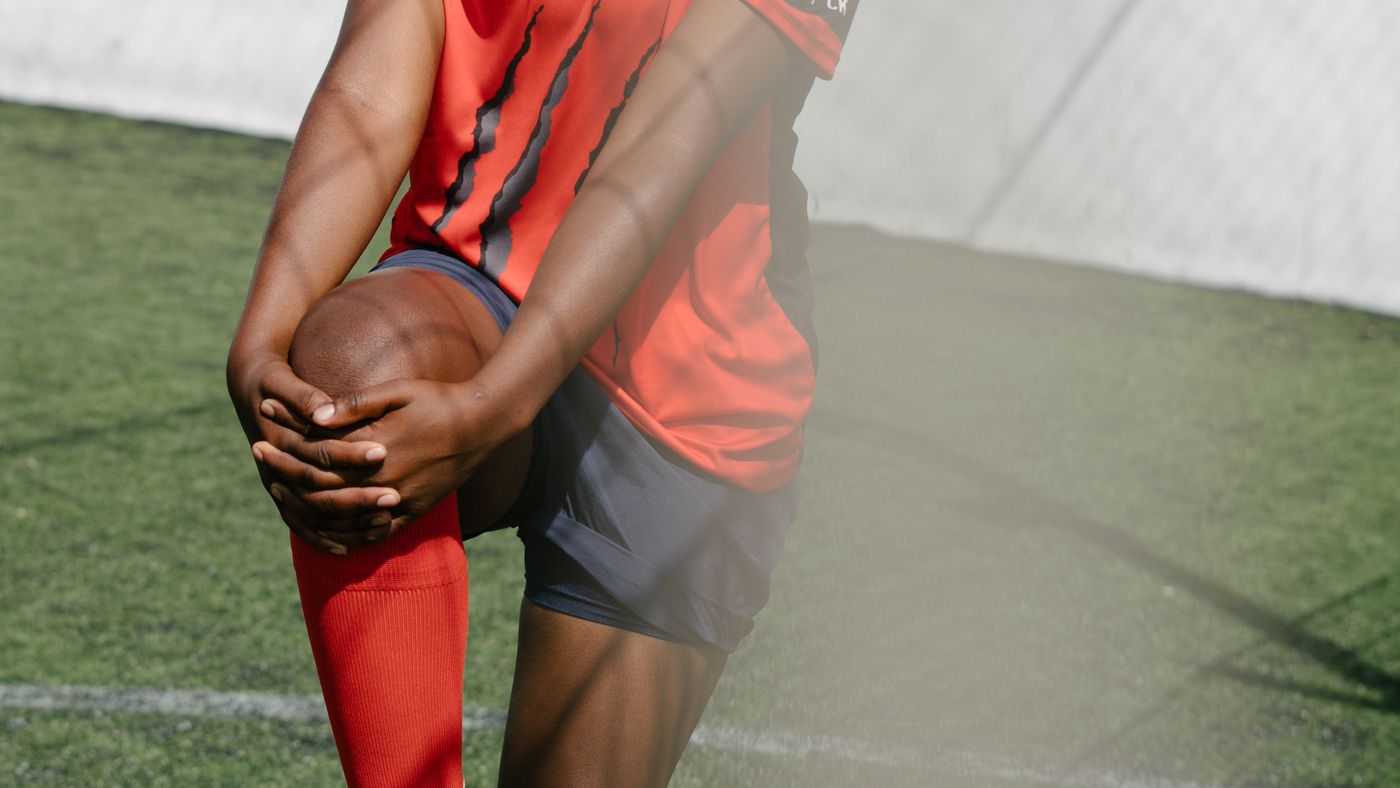
Osgood-Schlatter disease is a painful irritation of the bony bump just below the kneecap, where the patellar tendon attaches to the still-growing shinbone (the tibial tuberosity apophysis). It is often called a "growing pain" of the knee and turns up in active adolescents who run, jump and kick. Pulsed electromagnetic field (PEMF) technology is sometimes suggested for it. We found no PEMF trial in this condition, no PEMF safety data in adolescents with it, and no PEMF study in any review of its treatments. This is an evidence-gap brief: it shows what the Osgood-Schlatter research does test, and what the benchmark care achieves.
How common it is
We looked for a figure from an official US source (CDC, NCHS, NIH, NIAMS, MedlinePlus). The MedlinePlus entry describes the condition as common in adolescents who play soccer, basketball and volleyball or do gymnastics, and as affecting more boys than girls, but it gives no US count or rate, and we found none elsewhere in those sources (MedlinePlus, Osgood-Schlatter disease). The frequency figures below come from the research literature, not from a US survey.
Prospective school cohort, 1,670 children followed for 5.5 years (Wedderkopp et al., Sports Medicine, 2026, Denmark). Parents reported injuries by weekly text message, and reports triggered a clinical examination. There were 1,265 episodes of lower-limb apophysitis; Sever's (heel), Sinding-Larsen-Johansson (lower kneecap) and Osgood-Schlatter disease made up more than 99% of them. Median episode length was 3 to 4 weeks, with a range of 1 to 45 weeks. Soccer, handball, basketball and jump gymnastics were linked to a higher risk (risk ratio 2.07 to 2.74); extra physical education was not. (PubMed 41182572)
What the trials measured
The search: no PEMF trial in Osgood-Schlatter disease
On 2 November 2026 we searched PubMed for pulsed electromagnetic field, PEMF, electromagnetic field, magnetotherapy, magnetic field therapy and magnetic therapy combined with Osgood, tibial tuberosity and apophysitis. The search returned 2 records, and neither is a PEMF study in Osgood-Schlatter disease:
- A 2025 narrative review of lower-limb osteochondroses in children (PubMed 41133728). Its abstract discusses imaging, prognosis and platelet-rich plasma injections, not PEMF.
- A single case report of a pelvic apophysis injury in a teenage soccer player who received radial pressure waves, focused shockwave and a high-energy electromagnetic modality together (PubMed 42461519). It is one patient, at the hip rather than the knee, with no control and with shockwave in the mix, so nothing can be attributed to an electromagnetic field. It is not evidence for Osgood-Schlatter disease.
A broader search for every Osgood-Schlatter record that mentions a magnetic or electromagnetic term returned 49 records; they were MRI and imaging studies, case reports and reviews, with no PEMF treatment study among them. A search for PEMF or magnetotherapy combined with adolescent knee conditions found no trial in growth-related knee pain.
What the reviews of Osgood-Schlatter treatment contain
Systematic review of conservative treatment, 13 studies, 747 patients, 937 knees (Neuhaus et al., Physical Therapy in Sport, 2021). Studies published from 1948 to 2019 were included, only two of them randomized trials, and study quality was poor to moderate. Some approaches, such as stretching, had apparent efficacy, but no randomized trial compared specific exercises with sham or usual care. The authors call for carefully controlled trials of well-described treatments. No PEMF study was among those included. (PubMed 33744766)
Systematic (scoping) review of all treatments, 15 studies, 712 patients (Ndjonko et al., Orthopaedic Journal of Sports Medicine, 2026). The studies were nonoperative (7), injection-based (4) and surgical (6). Nonoperative care (physical therapy, immobilization, supportive care) led to full recovery of daily activities in 14.3% to 100% of cases, with complication rates of 0% to 66.7%, mostly quadriceps wasting and skin irritation. Full recovery after injections ranged from 31.8% to 84.3%. Surgery, generally reserved for persistent symptoms after the growth plate had closed, returned 79% to 100% of patients to daily activities, but 5 of the 6 surgical studies reported complications, at rates of 0% to 75.8%. The review is graded level of evidence 4 and lists no PEMF study. (PubMed 41788553)
The benchmark: exercise, load management and education
Prospective cohort, 51 adolescents aged 10 to 14, no control group (Rathleff et al., Orthopaedic Journal of Sports Medicine, 2020). A 12-week program of activity modification guided by pain, progressive knee and hip strengthening and a staged return to sport was tested in adolescents who had had pain for a mean of 21 months. 80% reported a successful outcome at 12 weeks and 90% at 12 months, but only 16% had returned to sport at 12 weeks, rising to 69% at 12 months. Knee extension strength rose 32%. Without a control group, natural recovery cannot be separated from the effect of the program. (PubMed 32284945)
Randomized trial protocol, target 130 participants aged 10 to 16 (the SOGOOD trial, Krommes et al., BMC Sports Science, Medicine and Rehabilitation, 2024). This assessor-blinded trial compares the same self-management approach with usual care, with knee function in sport at 5 months as the primary outcome. The protocol notes that earlier reviews found low-level evidence for surgery and injections and an absence of studies on conservative management. As of our search it has published a protocol, not results. (PubMed 38643184)
The injection trials, including a null result
Double-blind randomized trial, 38 adolescents, 49 knees (Nakase et al., Archives of Orthopaedic and Trauma Surgery, 2020). Monthly injections of dextrose with lidocaine were compared with saline with lidocaine for 3 months in patients who had not responded to at least 1 month of conservative care. Both groups improved on the VISA knee score at 1 month, and there was no significant difference between the groups at any time point. (PubMed 31713082)
Double-blind randomized trial, 70 patients (Wu et al., Archives of Orthopaedic and Trauma Surgery, 2022). Ultrasound-guided 12.5% dextrose was compared with saline. The dextrose group improved more on the VISA-P score at 3 months (mean difference 25.4 points, 22.4 to 28.3) and 6 months (mean difference 6.2 points, 3.2 to 9.4). Both groups improved by a clinically important amount, which the authors read as both injections being active treatments. (PubMed 34673998)
Systematic review and meta-analysis, 4 studies (3 randomized trials and 1 case series), 166 patients, 184 knees (Rhim et al., Diagnostics, 2025). At 3 months, dextrose was not significantly better than placebo injection on patient-reported improvement (standardized mean difference 1.92, 95% CI -0.12 to 3.96, heterogeneity 96.2%). Two trials in athletic adolescents gave a pooled risk ratio of 2.11 (95% CI 1.12 to 3.98) for pain-free return to sport at 3 months, and two trials favored dextrose at one year (standardized mean difference 1.09, 95% CI 0.62 to 1.56). 162 of the 166 patients were male. The authors call for further high-quality trials. (PubMed 40428275)
Why "it goes away on its own" is not the whole story
Prospective cohort, 51 adolescents aged 10 to 14, 46 followed for 24 months (Holden et al., Orthopaedic Journal of Sports Medicine, 2021). At 2 years, 37% (17 of 46) still had knee pain from Osgood-Schlatter disease, a median of 42 months after symptoms began. More than 1 in 5 had stopped sport because of knee pain, and those with ongoing pain scored lower on sport function (KOOS Sport/Recreation mean 74 vs 91) and quality of life. An ununited bone fragment was seen on ultrasound in 32% of those scanned at follow-up. (PubMed 34435066)
National registry cohort, 400 of 1,281 adults diagnosed with Osgood-Schlatter disease in Danish hospitals in adolescence, 1977 to 2020 (Krommes et al., Sports Medicine, 2025). 85% reported a current bony prominence below the knee and 73% sustained pain or problems in the same area. They scored lower than healthy population estimates on every KOOS subscale, most of all on sport and quality of life, and had higher odds of "jumper's knee" (odds ratio 70.4, 95% CI 32.9 to 155.0). Only 400 of the 1,281 people identified responded, and the comparison was with published population estimates rather than a matched control group, so the gap may be overstated. (PubMed 40439870)
The nearest PEMF evidence: adult knee tendon pain
The closest conditions with PEMF research are in adults: anterior knee pain and patellar tendinopathy, where the same tendon is involved but the growth plate is closed and the disease is different. Those trials, including any that found no difference from sham, are set out in our anterior knee pain and patellar tendinopathy brief. They tell you nothing directly about a growing adolescent's tibial tuberosity.
Where the evidence stops
- Direct PEMF evidence in Osgood-Schlatter disease is zero: no sham-controlled trial, no comparative trial, no case series. The two records our PEMF search returned are a review that does not discuss PEMF and a single hip case that received shockwave plus another modality.
- There is no PEMF safety or dosing data in adolescents with Osgood-Schlatter disease or other growth-related knee pain, and none on applying PEMF over an open growth plate in this population. Adult knee trials do not answer that question.
- The Osgood-Schlatter research is itself thin: the conservative-care review found only two randomized trials among 13 studies, and the main exercise program has cohort data, with its randomized trial still unpublished.
- The injection evidence is mixed: one double-blind dextrose trial was null, another was positive, and the pooled 3-month result was not significant.
- Extracorporeal shockwave therapy (ESWT) has been reported in Osgood-Schlatter disease and other youth apophysis injuries. Shockwave is a mechanical acoustic-pressure treatment, not a pulsed electromagnetic field, and those reports are not PEMF evidence and are not covered here. Laser, therapeutic ultrasound, TENS and transcranial magnetic stimulation are not PEMF either; their results do not transfer.
What to ask when you evaluate a clinic model
- Does any claim about Osgood-Schlatter disease or "growing pains" of the knee cite a PEMF trial in adolescents with the condition? Ask for it by name. We found none.
- Is an adult patellar tendinopathy, knee osteoarthritis or shockwave result being presented as evidence for a teenager's knee?
- What safety data supports applying the device over an open growth plate, and who decides whether a minor receives it at all?
- Will adolescents be seen alongside, never instead of, the pediatricians, sports medicine physicians and physical therapists who provide load management and strengthening, the benchmark care in this condition?
- How will pain, sport participation and knee function be recorded for every adolescent, not only those who do well, given that many recover with time and load management alone?
- Can the seller show you this research, with its gap, the way it is written here?
Questions buyers ask
Is there a PEMF trial in Osgood-Schlatter disease?
No. Our PubMed searches found no PEMF study of any design in this condition, and no review of its treatments includes one.
What does the Osgood-Schlatter research test instead?
Activity modification with strengthening and education, stretching, bracing, dextrose and platelet-rich plasma injections, and surgery for persistent cases after growth has finished.
Is there safety data on PEMF in adolescents with knee pain?
We found none for Osgood-Schlatter disease or other growth-related knee pain.
Do shockwave studies in Osgood-Schlatter disease count as PEMF evidence?
No. Shockwave is a different technology, and its studies are not PEMF evidence.
The regulatory side
FDA decisions on PEMF devices are specific to one device, one model and one indication, and they do not carry over to other devices. No FDA decision we know of covers PEMF for Osgood-Schlatter disease. Before you rely on any device for a clinic, look up its own FDA record, including any age limits in its labeling. Our guide PEMF and the FDA explains how, and what the technology's record since 1979 does and does not cover.
Read the research yourself
Every study above links to its PubMed abstract. More published PEMF studies, each checked against the original paper: pemf-research.com. Compare with our anterior knee pain and patellar tendinopathy, Achilles tendinopathy and knee ligament and meniscus surgery recovery briefs.
About the publisher
These guides are written by PainFree. PainFree has run pain-relief clinics in Israel for 25 years, and more than 70 operate today; its Israeli site, in Hebrew, is painfree.org.il. We would want any buyer to read the evidence behind a clinic model this carefully, ours included.
Related research on this site
This article is general information for prospective business owners. It is not legal, financial or medical advice. We do not make earnings claims, and this page is not an offer to sell a franchise or a business opportunity. Study results describe the trials cited, not any particular device or clinic. Equipment supplied to US clinics will meet the applicable US regulatory requirements.