
Evidence brief for clinic investors
Foot pain from standing all day: what the research shows
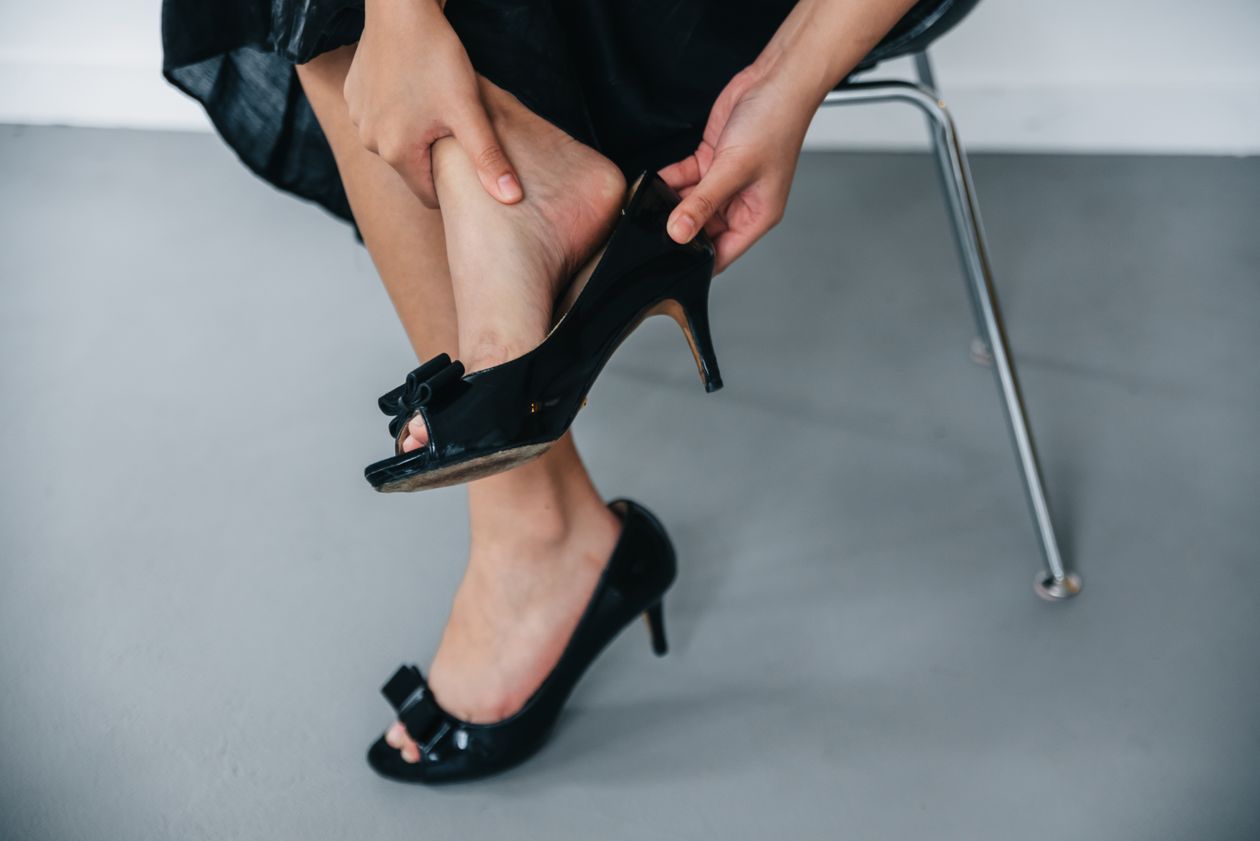
Heels and arches that ache by the end of a shift are one of the most common complaints among nurses, retail staff, cooks, warehouse workers and anyone else who spends the day on their feet. Anyone evaluating a clinic business will meet this complaint constantly. This brief sets out what the research says about standing and foot pain, how time on the feet relates to plantar fasciitis, what footwear and physical therapy studies report, and what pulsed electromagnetic field (PEMF) trials actually measured, including where they found nothing and the fact that none measured pain from standing itself.
Is standing all day linked to foot pain?
Yes, in observational research. Reviews link prolonged standing at work to leg pain, fatigue and discomfort, and in one large survey of street vendors each extra hour of daily standing went with higher odds of heel pain.
Review of health risks and interventions for prolonged standing at work (Waters & Dick, National Institute for Occupational Safety and Health, Rehabilitation Nursing, 2015). The authors found ample evidence that prolonged standing at work leads to adverse health outcomes, including lower back and leg pain, fatigue and discomfort. They also note that studies could be improved with more precise definitions of prolonged standing, better measurement of the health outcomes and more rigorous protocols. (PubMed 25041875)
Cross-sectional study, 936 street vendors in Delhi (Sharma et al., Scientific Reports, 2025). Heel pain was reported by 46.1% of participants. Vendors with heel pain stood longer each day on average (6.2 against 5.8 hours) and had a higher body-mass index (27.4 against 23.8). In the adjusted model, each hour of daily standing (odds ratio 1.19; 95% CI 1.08 to 1.30) and higher body-mass index (odds ratio 1.15; 95% CI 1.08 to 1.21) were significant predictors. A single survey at one point in time can show an association, not a cause. (PubMed 41225086)
Not every sore foot after a shift is a mechanical overload problem. Numbness, burning or tingling, a hot or swollen foot, pain after a fall or twist, an open sore on the foot, or one calf that swells and hurts are signs that call for a physician rather than a general program.
Does time on your feet raise the risk of plantar fasciitis?
It is one of several risk factors, and not the strongest. A tight ankle and obesity carried larger odds than time on the feet, and a systematic review rated the evidence on weight-bearing at work as low quality.
Matched case-control study, 50 patients with plantar fasciitis and two age- and sex-matched controls each (Riddle et al., Journal of Bone and Joint Surgery, 2003). People who spent the majority of the workday on their feet had an odds ratio of 3.6 (95% CI 1.3 to 10.1). A body-mass index above 30 carried an odds ratio of 5.6 (95% CI 1.9 to 16.6), and ankle dorsiflexion of 0 degrees or less an odds ratio of 23.3 (95% CI 4.3 to 124.4) against more than 10 degrees. The authors judged reduced ankle dorsiflexion the most important of the three independent risk factors. (PubMed 12728038)
Systematic review, 4 studies of weight bearing and plantar fasciitis in workers (Waclawski et al., Occupational Medicine, 2015). All four studies were rated high or unclear risk of bias. Two case-control studies and one cross-sectional study found an association with weight bearing, measured in different ways. The review found low-quality evidence of an association between plantar fasciitis and weight-bearing tasks such as walking and standing on hard surfaces, and the evidence was not enough to confirm a causal relationship. (PubMed 25694489)
Do shoes, insoles and workplace changes help?
The research points that way, but mostly in narrative reviews rather than pooled trial results. Sole hardness, arch support and custom insoles all change comfort for people who stand at work.
Systematic review of footwear and foot comfort in prolonged standing occupations (Kang et al., Safety and Health at Work, 2026). Results were synthesized narratively because study designs and outcomes varied. Soft soles reduced foot impact and fatigue but offered limited support; hard soles improved stability but could cause localized pressure and discomfort. Semirigid arch supports could cause discomfort, most insoles improved pressure distribution, and custom orthotic insoles outperformed standard ones in comfort and balance. (PubMed 41907659)
The NIOSH review cited above lists floor mats, sit-stand workstations or chairs, shoes, shoe inserts and stockings as suggested interventions for prolonged standing. A clinic model that sees standing workers has to sit alongside these, not replace them.
What do physical therapy treatments show for plantar fasciitis?
Less than many people assume. A recent meta-analysis of physiotherapy trials found a trend toward lower pain at one month that did not reach significance, no change in function, and low-quality evidence overall.
Systematic review and meta-analysis, 21 randomized trials, 1,196 participants with plantar fasciitis (Raj et al., Musculoskeletal Care, 2025). Interventions included shockwave therapy, kinesiology taping, laser, manual therapy and needling. At one month, pain showed a non-significant trend toward reduction (SMD −0.39; 95% CI −0.89 to 0.11; p = 0.125; I² = 88.7%), and function showed no improvement (SMD 0.00; 95% CI −0.20 to 0.20). Heterogeneity was high and evidence quality low. PEMF is not among the interventions named in the abstract. (PubMed 40596749)
Did any PEMF trial measure foot pain from standing?
No. No PEMF trial cited here enrolled standing workers or measured pain during or after a day on the feet. The closest evidence is two plantar fasciitis trials that rated morning and evening heel pain: one found morning pain fell 40% against 7% with a placebo device (PubMed 22297104), the other found evening pain fell more with PEMF added to physiotherapy (PubMed 42708522), and in each trial the other time of day showed no significant difference between groups.
Double-blind, multicenter, placebo-controlled randomized trial, 70 patients with plantar fasciitis (Brook et al., Journal of Foot and Ankle Surgery, 2012). Participants wore a small pulsed radiofrequency electromagnetic field (PRFE) device or a placebo device overnight and rated morning and evening pain on a 0 to 10 scale. By day 7, morning pain was 40% lower than on day 1 in the active group against 7% in the placebo group (p = 0.03). Evening pain, the time of day closest to the end of a shift, fell 30% against 19%, a difference that was not significant. Medication use trended down only in the active group. Limits: the device works in the radiofrequency range rather than low-frequency PEMF, and the outcome was measured after one week only. (PubMed 22297104)
Randomized trial, 40 patients aged 20 to 68 with plantar fasciitis (Arani et al., Isfahan University of Medical Sciences, Bioelectromagnetics, 2026). Conventional physiotherapy alone or conventional physiotherapy plus PEMF, assessed at the tenth session and 4 weeks later. Both groups improved. Evening pain and the Foot Function Index fell more with PEMF added (p < 0.05); morning pain did not differ between groups. Limits: no sham group, 40 participants, and the abstract reports no effect sizes. (PubMed 42708522)
What does PEMF research show across foot and ankle soft-tissue conditions?
A small evidence base with mixed results. A 2026 systematic review (PubMed 41716305) found lower pain in 3 of 4 trials but better function in only 1 of 3, and the sham-controlled Achilles trial found no added benefit. Our foot and ankle soft-tissue brief goes through the trials.
Systematic review of 4 randomized controlled trials, 243 participants with foot and ankle soft-tissue conditions, mean age 49 (Chia et al., Frontiers in Sports and Active Living, 2026). In 3 of the 4 trials, PEMF was given alongside another conservative treatment such as shockwave therapy, heel pads or eccentric exercise; only one tested PEMF alone against sham. Three trials reported significantly lower pain than controls (p < 0.05), and only one of three showed significantly better physical function. Protocols varied widely, and no serious adverse events were reported; minor skin redness was the only side effect documented. (PubMed 41716305)
Randomized, sham-controlled trial, 65 patients with Achilles tendinopathy (Ko et al., Chinese University of Hong Kong, Orthopaedic Journal of Sports Medicine, 2024). PEMF twice a week for 8 weeks plus 12 weeks of eccentric exercise, against the same exercise with sham. VISA-A scores rose in both groups (57.9 to 71.7 with PEMF, 55.1 to 66.8 with sham) with no difference between groups (p = 0.527); pain during sport fell in both (6.05 to 2.95 against 6.45 to 3.85) with no difference (p = 0.346). The authors concluded PEMF did not improve outcomes over exercise alone. (PubMed 39534390)
Where does the PEMF evidence stop?
Short of standing. No PEMF trial cited here measured pain from prolonged standing, enrolled people because of their work, or followed them through a working day.
- No trial measured foot pain during or after a shift on the feet.
- In the sham-controlled plantar fasciitis trial, evening pain did not differ significantly from placebo, and the result covers one week of a radiofrequency device.
- The trial that found less evening pain had no sham group, and morning pain did not differ.
- The sham-controlled Achilles trial found no added benefit over exercise.
- Trials were small, follow-up was short, and devices and protocols differed widely. A result belongs to the protocol that was tested, not to every device sold under the PEMF label.
What should a buyer ask when evaluating a clinic model?
- How are people with foot pain screened for numbness or burning, swelling, a recent injury, an open sore or calf swelling, and where are they referred?
- How does the model sit alongside footwear, insoles, calf and foot exercise, weight management and changes to the workplace?
- Which protocols will be used, and which published trials, with which outcomes, are they based on?
- Will pain be measured at the times that matter to standing workers, for example at the end of a shift, rather than only as a general score?
- Does the seller show the trials that found no difference from sham as openly as the positive ones?
What has the FDA decided about PEMF technology?
The FDA record of PEMF starts in 1979, when a PEMF bone growth stimulator received premarket approval (PMA P790002) for non-union fractures. Pain and swelling after surgery fall under their own classification regulation, 21 CFR 890.5290(b), nonthermal shortwave therapy: a prescription device that applies pulsed electromagnetic energy and is used adjunctively for postoperative pain and soft-tissue edema, reviewed through 510(k). Neither indication is plantar fasciitis or foot pain from standing. Each FDA decision covers one device, one model and one indication, and does not extend to other devices or uses. Our guide PEMF and the FDA explains how to look up a device's own record.
Where can I read the research myself?
Each study above links to its PubMed abstract. More published PEMF studies, each checked against the original paper, are at pemf-research.com. Related reading: our plantar fasciitis and heel pain brief, the foot and ankle soft-tissue brief and the companion question on back pain when standing.
Who publishes these guides?
These guides are written by PainFree. PainFree has run pain-relief clinics in Israel for 25 years, and more than 70 operate today; its Israeli site, in Hebrew, is painfree.org.il. We would want any buyer to read the evidence behind a clinic model this carefully, ours included.
Related research on this site
This article is general information for prospective business owners. It is not legal, financial or medical advice. We do not make earnings claims, and this page is not an offer to sell a franchise or a business opportunity. Study results describe the trials cited, not any particular device or clinic. Equipment supplied to US clinics will meet the applicable US regulatory requirements.